
How do you teach advanced yoga poses?
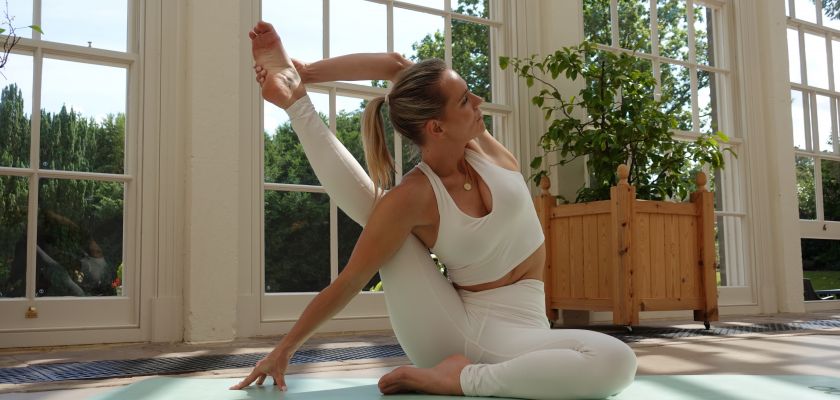
Hello friends and welcome back to another blog! Last week we focussed on 'How do I plan a yoga class?', and we mentioned at the end about how to plan a class for mixed abilities, a plan to please everyone ..if such a thing should exist! So this week we’re going to give a few tips and tricks for offering options, building intensity and teaching each individual student in your class at the same time!
I know you’re thinking ‘that’s not possible’ but it most definitely is, trust me ..I’m a yoga teacher!
How do you teach advanced poses?
So my advice with planning for mixed abilities, is to still plan your class based on your beginner student. However we want to plan in a way that allows us to lead on to more complex postures, or have space and time to offer additions to build intensity. Here are some examples:
Let's consider a complex peak pose, so perhaps bird of paradise would be a good place to start.
There are a couple of ways in which you can come into bird of paradise, but if you're teaching a mixed abilities class, a nice way to introduce this pose is from Side Angle. So before we think about how to move from Side Angle to Bird of Paradise, we need to consider that these are two very different postures, with very different areas that are required to be warm before we can come into either of them. So this class is going to have to be broad from the outset - for Side Angle we need to consider hips, the side body and shoulders. For Bird of Paradise we need to consider the heart space, the shoulders, the hips and also the hamstrings.
So now we have the areas that we need to focus on we can start to build our class around these particular areas.
Then we can consider moving students from Side Angle with options to move towards Bird of Paradise.
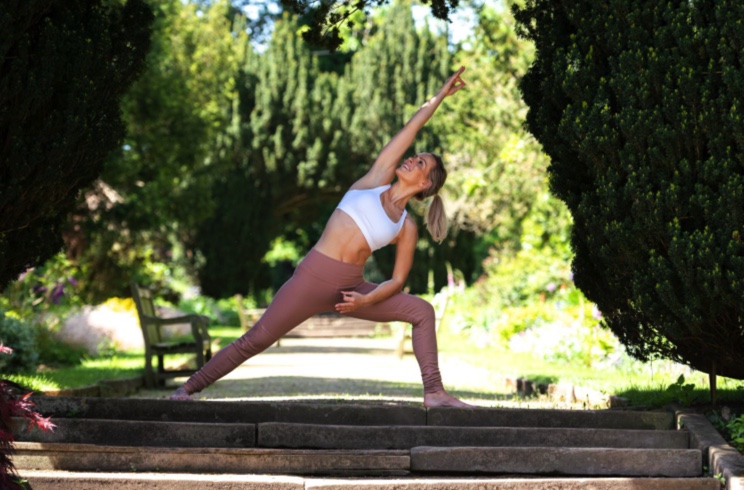
So from the Side Angle (we’ll use the left side as an example), we would give students the option to stay there, or to lower the left down to a block or the mat, if students want more, we can offer for them to release the right hand down behind to the lower back and reach the left arm underneath the front leg and up towards the back, where it would meet either the bottom of a strap being held by the right hand, or the right hand itself. From here we want students to consider opening out through the heart space rolling that right shoulder back
It is at this point we can offer that students can stay here as an option, or they can look towards the top of them mat and take a step forward with the right foot to meet the left foot maintaining the bind.
Then we can offer students the option to stay here or if they'd like to start to lift, they would ground through the right foot (foot without the bind) and come onto the ball of the left foot (the foot that has the bind), and then if they would like to they can start to come into a stand, maintaining the bind, and if they stand they can start to lengthen the leg that is bound to find Bird of Paradise.
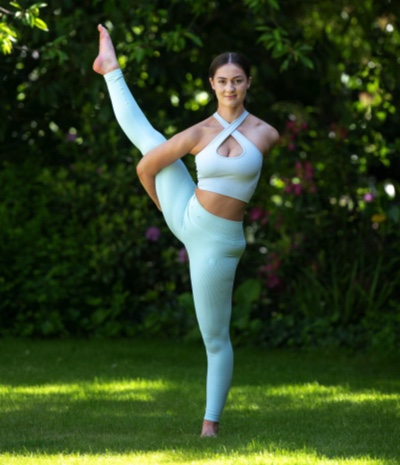
So you have lots of options here to build students up to Bird of Paradise - and for students that are still in Side Angle you perhaps want to offer at the point of the option to step forward with the bind, to talk to students that are in Side Angle about lifting up to Warrior Two and stepping forwards to the top of the mat and then finding a Deep Forward Fold ..guiding your Bird of Paradise students there once they have released the leg down.
We won’t lie, it can feel complicated guiding so many options, but as with anything, it gets better with practice. So talk it through a few times before you take it to the mat to teach, as you would with any new transition!
How do you build intensity in a yoga class?
Offering the opportunity to build intensity within the class is quite a simple addition that can really make a difference for students who want more. If you're teaching a fast paced vinyasa style class then simply offering a number of vinyasas that students can do by themselves if they want to, and then meet in a Child's Pose or a Downward Facing Dog when they’re finished, is a great option to give. So how I would use something like this is from Downward Facing Dog I would cue ‘..option one, two, three or four vinyasas, are yours if you would like them and when you’re ready, we'll meet in a Child's Pose, grab a drink here if you need one.’ Of course the number of vinyasas you offer is entirely based on the class that you’re teaching, so if it is that fast paced vinyasa then perhaps offering up to four additional vinyasas is a nice amount, if you were teaching more of a Hatha based class, then maybe offering just one additional vinyasa if students would like it would work here.
We can also build intensity through little things like, lifting the from heel from the mat in a lunge, this adds more intensity into that front leg balancing on that smaller surface area. Or an option to remain still in a pose or for more intensity you could include a flow of lifting and lower the arms ..a very simple example, but something that just offers that little bit more for your students who want it.
Teaching yoga.
Don’t ever be afraid to teach complex or advanced poses - you want your students to have things to work towards in classes, but finding a way to break them down is the key, so everyone has that sense of achievement no matter what point they’re at ..and remember, as always, it’s not about you, and what you can or can’t do, as long as you can verbally tech and cue, then that is all your students need!
Want to know more?
If you'd like to learn more about seqencing, there is a whole module on class planning and seqencing on our 200hr Yoga Teacher Training, and more advanced seqencing modules on our 300hr Yoga Teacher Training and 500hr Yoga Teacher Training. You can download our syllabus for all of these courses on our website, and if you have any further questions please send us an email to info@yogacourse.com


hey there!
.jpg)
We would like our blog to be a place where you learn new things in the world of yoga, when it comes to business of yoga, asanas, philosophy and pranayama.


.jpg)
