How do I plan a yoga class?
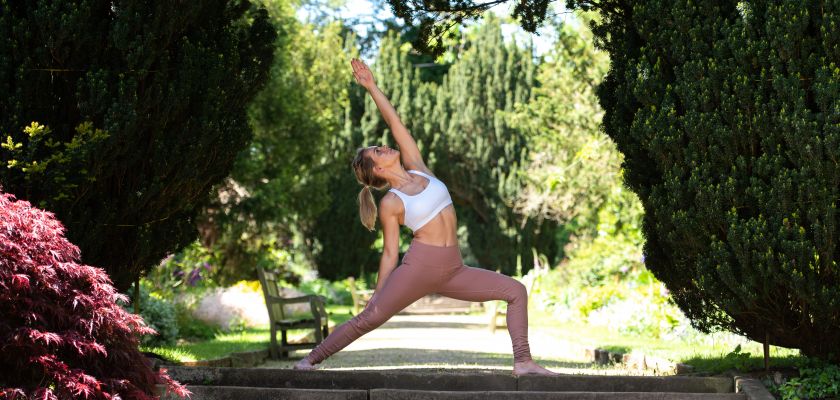
Welcome back friends! This week we're going to be looking at how to plan a yoga class, ..sounds easy right? I mean you know the poses, so how difficult can it be to put them together? If this is something you struggle with, don't worry you're not alone. As online educators in the yoga field through Yoga Course, we get asked questions time and time again on this subject ..more so than any other aspect of teaching yoga.
So here's some of our most frequently asked questions and our answers for you, so that hopefully next time you come to plan a class, it won't feel quite as daunting.
What postures do I choose when planning a yoga class?
This is probably the most common question we get, and ultimately it comes down to a couple of choices that you need to make - theme or peak pose.
We feel these two things are pretty essential when planning a class, alongside anatomy ..this is something that should always be considered when planning a class. Some of the questions you should be asking yourself are things like:
What am I asking of my students?
Have I prepped my students body enough to include this pose?
How many technical poses have I included ..is that asking too much in one class?
We can work to a theme for a class and create perhaps more of a full body experience for our students, or we can work to a theme and work on 1 or 2 areas of the body, or we can work to a peak pose and build the class around that particular posture ..but we should always consider anatomy along the way.
Theme
Your theme for a class as an example could be Chakra related (for more information on Chakras you can check out our previous blog What is a Chakra? - so lets consider the Root Charka - Muladhara. For this Charka we could include poses such as:
Easy Pose
Childs Pose
Yogi Squat
Deep Forward Fold
Low Lunge
Warrior 2
Bridge
Wide Leg Forward Fold
Anatomy
Considering anatomy here - if we wanted to plan our Root Chakra poses into a class, there is one pose within our list that although it fits with our theme of Root Charka, it doesn't fit anatomically with the other postures we have.. let me explain:
Easy Pose (hips)
Childs Pose (hips)
Yogi Squat (hips)
Deep Forward Fold (hamstrings)
Low Lunge (hips)
Warrior 2 (hips)
Bridge (heart opening)
Wide Leg Forward Fold (hamstrings)
So you can see from above that all of our Root Chakra poses are related to the hips and hamstrings, all of them but Bridge Pose which is heart opening. So we have some options - we can either not include Bridge, or we need to consider offering something that will prep our students for this heart opening pose.
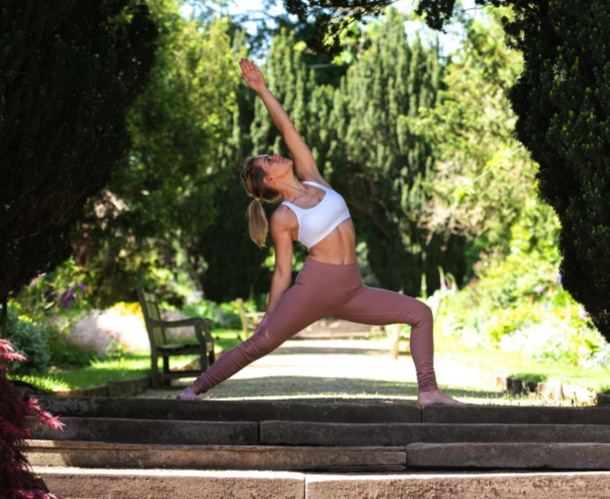
If we've included Sun Salutations within our class, we will have included either Sphinx or Cobra, which are both great prep for Bridge. We should perhaps consider adding something else which will add a slightly bigger stretch for the front body and heart space - so a pose that works well with our theme and fits with our other poses anatomically, would be Reverse Warrior. This pose still relates to the hips, still relates to the Root Charka and still relates to being heart opening, so will prep our students bodies for Bridge.
How do I transition yoga poses together?
Again a common question we have, is students not feeling certain of how to put poses together to make that all important sequence.
Sequencing postures together is really based on if the transition between them is suitable, and also the section of the class you’re in. In a warm-up section for example, we want students to slowly move their way through and up to perhaps some standing postures at the Middle 1 stage.
We should also consider here the flow of movement, so for example if we’ve started in a supine position, we should do any other warming supine movements here, and then move students to seated or four point kneeling. We don’t want to bring them up, to immediately bring them down again. Similarly at the end of a class, we wouldn’t want to bring students down to the mat for some cooling postures but then ask them to stand or sit again for a posture.
So if we continue with our postures above, firstly we need to split them into class sections (Warm-up, Middle 1, Middle 2 and Cool-down)
Easy Pose (Warm-up / Cool-down)
Childs Pose (Warm-up / Cool-down)
Yogi Squat (Middle 2)
Deep Forward Fold (Middle 1 / Middle 2)
Low Lunge (Warm-up / Middle 1 / Middle 2)
Warrior 2 (Middle 2)
Bridge (Middle 2)
Wide Leg Forward Fold (Middle 2)
Reverse Warrior (Middle 2)

Then we need to use trasntional postures, and of course some other relevant poses to link them together. When we say relevant poses, either poses that fit the the theme, or are working with elements from the peak pose, but that suit anatomically. So lets a build a Warm-up.
Warm-up
Corpse Pose - Pose for settling, grounding and meditation before the physical practice begins
Knees to Chest (circle knees) - gently brings some movement to the body but also into the hips
Reclined Butterfly - a reclined pose to externally rotate both hips
Reclined Pigeon - a reclined pose to externally rotate one hip and adds some stretch into the hamstrings
Bring students up into a seated position
Easy Pose - a seated position to settle and ground, alongside externally rotating both hips
Easy Pose with side stretches - externally rotating both hips, stretches into the side body and warms the shoulders in preparation for any work later on where the arms will reach overhead
Bring the students onto hands and knees
Table Top - an opportunity to neutralise the spine, and ground
Cat / Cow - warms the spine, and starts to work with opening the heart space
Childs Pose - resting posture still working with the hips
*Table Top - again an opportunity to neutralise the spine, and ground, but also here a good transitional posture to move into a Low Lunge
Low Lunge - first bigger question for the hips
*Repeat
Table Top - neutralise the spine and transitioning pose
Downward Facing Dog - spine, hips, hamstrings, wrists, ankles ..lots going on here as well as it being a fantastic transitional posture to come into standing
Deep Forward Fold - First focussed stretch into the hamstrings and a great way to continue that transition up into standing.
Middle 1
This section really about building heat, so from Deep Forward Fold we can ask students ripple up through the spine to standing and bring them into a Mountain Pose, ready for the start of a Sun Salutation. A good choice here would be the Classical Sun Salutation as it offers Low Lunges which fits with our theme of the Root Chakra, and also has a standing backbend which will add addtional prep for Reverse Warrior and Bridge later on in the class.
Midde 2
Now we need to build a Middle 2 section from Mountain Pose which will be the end of our Sun Salutation.
Deep Forward Fold
*Low Lunge - here we could lift the arms overhead
Runners Lunge - Transitional pose to lift the back knee from the mat, and lower the back foot in preparation for Warrior 2
Warrior 2 - External rotation
Reverse Warrior - External rotation and heart opening
Warrior 2
Wide Legged Fold - Hamstrings
High Lunge - Transitional pose to square the hips forwards in preparation for Downward Facing Dog
Downward Facing Dog
Plank
Four Limb Staff Pose
Cobra
Downward Facing Dog
Deep Forward Fold
*Repeat on the other side
Yogi Squat - Deep and loaded stretch, externally rotating through both hips
Deep Forward Fold
Downward Facing Dog
Table Top - Transitional pose to lower to the mat
Staff Pose- Transitional pose to lower to a supine position
Bridge
Cool-down
So now we have most of our class, it's time to bring students down to the mat for a Cool-down. We're already reclined from Bridge, so we now need to select a series of reclined options appropriate to the theme and ..you guessed it - anatomy!
Knees to Chest
Happy Baby - A reclined option for the hips
Reclined Hand to Big Toe - A reclined option for the hamstrings
Reclined Cow Face Legs - A reclined option to find some internal rotation and close the hips
Windmill Knees - A reclined option to find some internal rotation and close the hips
Reclined Twist - A calming way to find some stillness and continue with closing the hips down
Corpse Pose
How do I transition students between poses?
Imagine being in your first yoga class, and all you hear is ‘exhale Downward Facing Dog, inhale left foot forward to Warrior 2’ - if you didn’t know what Warrior 2 looked like how are you going to get there? We need to say what we do.
As teachers we need to support and guide our students through the whole practice, not just the postures.
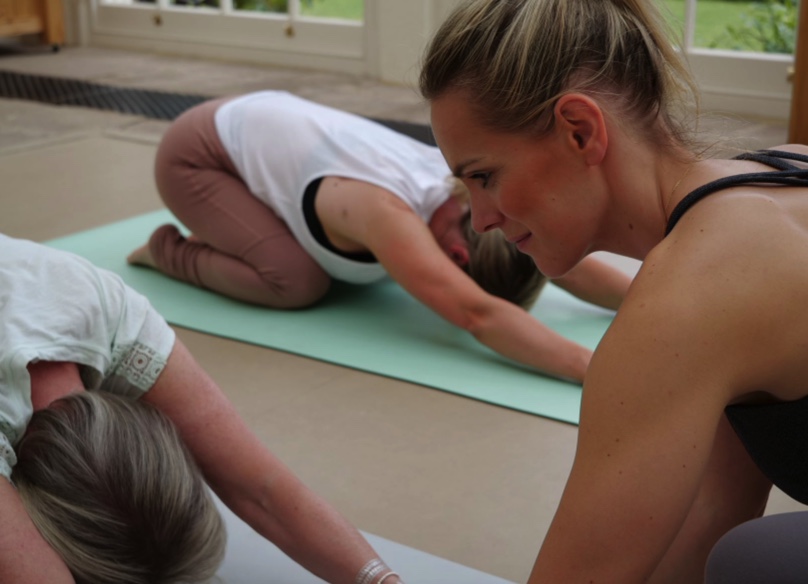
So going back to our Downward Facing Dog to Warrior 2 example, (we’ll use the left side in this instance) - here we want to talk to students about firstly lifting the the left leg upwards, leading with heel, keeping the hips square - this helps the student create momentum along with working the quadricep to lift the leg.
Then we want to look between the hands, and bring the foot through the gates of the arms …now this is tricky for a lot of students, so an inclusive cue here would be to ‘bring the foot through the gates of the arms, in 1 or 2 steps, or we can reach back and guide the foot forwards, lowering the back knee as an option to get there.’ This is a cue you can use for any instance where you're bringing the foot forwards from Downward Facing Dog.
So the front foot is in the right place, now we need guide the back foot ..'pivot on the back toes so you can plant of the foot to the mat at a 45-90 degree position, and here we’re looking for the front heel to be in line with the arch of the back foot.
Then we want to stabilise them ..‘ground through the outer edge of the back foot, lift the knee cap to engage the quadricep, ensure the front knee is stacked over the ankle, and draw the navel in towards the spine.’ Then you’re ready to lift them, and from there continue with Warrior 2 teaching points.
Sequences
Sequencing postures together is probably one of the trickiest things about being a yoga teacher, we have to consider ..is it safe and is it appropriate for that part of the class. Here are some good and bad example sequences below, for each of the four sections of a typical Hatha/Vinyasa style class.
Warm-up:
Good - Knees to chest, Easy Pose, Easy Pose with lateral bends, Table Top, Cat/Cow
Bad - Corpse Pose, Easy Pose, Happy Baby, Table Top, Cat/Cow, Reclined Pigeon
Here Reclined Pigeon means bringing the student back into a supine position after you've already brought them into a seat.
Middle 1:
Good - Low Lunge, Half Monkey, Runners Lunge, High Lunge
Bad - High Lunge, Warrior 2, Reverse Warrior, Locust
Here Locust would mean bringing the student from a standing backbend onto their front - we'd need to add more here to transition them down to the mat.
Middle 2:
Good - Warrior 2, Half Moon, Triangle, Wide Legged Fold
Bad - Warrior 1, Warrior 2, Warrior 3
Here we have hips square, a legs length distance between the feet, and heel to heel alignment for Warrior 1. Then we're asking students to come into external rotation, create a legs length and a half distance between the feet, and move the feet from heel to heel alignment to heel to arch. We also the have the hips in external rotation as we move into Warrior 3 where the hips are square.
Cool Down:
Good - Seated Cat/Cow, Seated Forward Fold, Knees to Chest, Reclined Hand to Big Toe
Bad - Seated Twists, Reclined Twists, Bridge, Sphinx, Table Top, Cat/Cow, Shavasana
Here we have two sets of twists in a row which might feel a bit too similar, then we are in a supine position for Bridge, and we ask students to come onto their front for Sphinx, Table Top and Cat/Cow, before again bringing them down to thir backs.
There are many different opinions on postures and where they can and can't sit in a yoga class, and it does truly depend on who you are teaching. So our advise would be to plan the basics around a beginner and have options to increase intensity or add additions should you be teaching a mixed abilities class. Perhaps we'll look at advancing seqences in another blog - if this is something you'd be interested in reading about, let us know via info@yogacourse.com - please use the subject line 'Weekly Blogs'
Start with a theme or a peak and build from there, but always keep anatomy in mind.
Want to know more?
If you'd like to learn more about seqencing, there is a whole module on class planning and seqencing on our 200hr Yoga Teacher Training, and more advanced seqencing modules on our 300hr Yoga Teacher Training and 500hr Yoga Teacher Training. You can download our syllabus for all of these courses on our website, and if you have any further questions please send us an email to info@yogacourse.com


hey there!
.jpg)
We would like our blog to be a place where you learn new things in the world of yoga, when it comes to business of yoga, asanas, philosophy and pranayama.


.jpg)
