Yoga - on and off the mat
What a week - so much change in the world since I last wrote. This week's blog was simply going to be based on poses that you could use yourself, or with your students to aid in relaxation. Based on the recent events in Ukraine, I’ve decided to make this a little bit broader, so not just postures, but yoga off the mat to help and support with things like anxiety, stress and looking at ways in which we can bring a deeper sense of calm and peace to ourselves and to others around us.
Firstly let's look at the physical.
Yoga poses to help you relax
Wide leg forward bend
Lizard Pose
Sphinx Pose
Supported Bridge
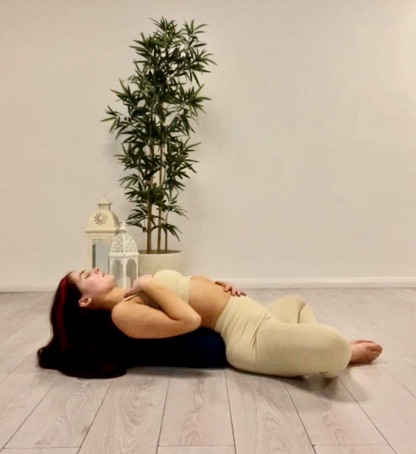
Reclined Twist
Reclined Bound Angle
Legs up the wall
Child's Pose
These poses can help with lowering blood pressure, slowing down your heart rate and breathing, they can improve digestion, ease muscle pain, improve your ability to sleep for longer periods of time and the quality of that sleep can also improve.
Continuing on with the physical elements that yoga can help us with ..let’s look at the breath and pranayama techniques.
Hannah Taylor
Breathing techniques to help relieve stress and anxiety
Simply just focusing on the breath can help you to relieve stress, as you are not giving the focus and attention to what it is that's causing you the stress anymore, you're focusing on your inhale and your exhale.
Breathing deeply, with a slow and even pace, sends signals to your parasympathetic nervous system to calm the body down, and that’s why the breath can be so beneficial to your mental and physical wellbeing, as it gives you a tool to be able to calm yourself mentally and therefore physically wherever and whenever.
Within Yoga we have specific Pranayama practices - in Sanskrit “Prana” means life energy and “Yama” means control.
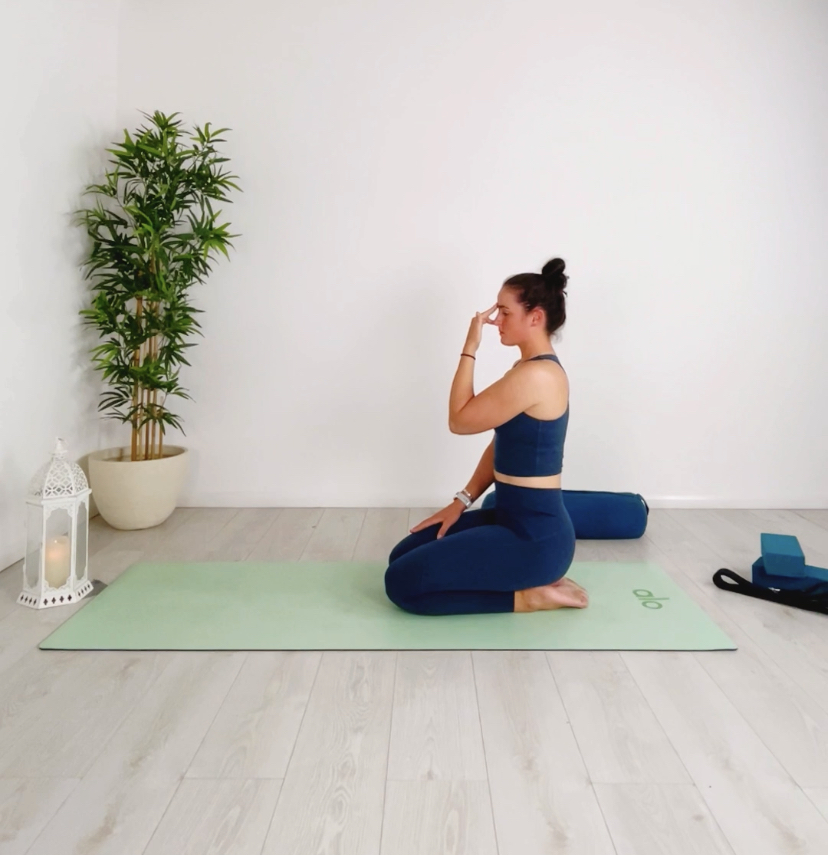
Nadi Shodhana
Nadi Shodhana is also known as Alternate Nostril Breathing can be one of the most beneficial in terms of calming the mind and balancing your energy as it reduces stress and anxiety.
To practice this breath simply sits it in a comfortable position with the spine neutral. Place the index and middle finger of your most dominant hand between the eyebrows or curl them into the palm, and rest your thumb and ring finger just above the nostrils. Place your other hand onto your lap, or on your knee with your palm facing up or down, or you can take a mudra of your choice. Take a full inhalation through both nostrils and a full exhalation. Close the right nostril, inhale through the left, pause at the top of the inhale. Close the left, pause, open the right and exhale, pause at the bottom of the exhale. Inhale through the right, pause at the top of the inhale, close the right, pause, open the left, exhale. This completes one round.
Annasley Park
Ujjayi Breath
Ujjayi also known as the Victorious Breath balances the cardiorespiratory system, it can be an energising breath but is also known for its relaxing benefits.
Beginners to this breath can complete it with the mouth open first and utilise the same sensation as if they were fogging up a mirror, making a ‘har’ sound.
To practice, this breath sits in a comfortable position with the spine neutral. Take a full exhalation and slightly contract the perineal muscles. Before inhaling draw the navel to the spine. Softly close the epiglottis and the top of the trachea - a small constriction at the back of the throat. Take a full inhalation, keeping the abdomen still. Exhale and maintain the constriction at the back of the throat.
Yoga philosophy to life off the mat
The Yamas form part of Patanjali’s 8 Limbs of Yoga.
Yama - Self-restraint
Niyama - Observance
Asana - Postures
Pranayama - Breath
Pratyahara - Withdrawal of senses
Dharana - Concentration
Dhyana - Meditation
Samadhi - Union
The Yamas and Niyamas both consist of 5 elements - and they’re basically like moral codes of conduct.
The first Yama and the one I want to focus on today is Ahimsa, which means non-violence.
This Yama at its root refers to not doing harm to any other living being. So that can relate to your neighbour an animal or yourself.
In terms of practising non-violence towards yourself and to others this is quite a straightforward choice that we make. Practising non-violence or non-harming towards yourself can simply mean for us as humans to allow ourselves time to look after ourselves. This might be through indulging in a favourite food, or practising yoga, or having a bath, taking a walk, spending some time reading a book, watching your favourite film ..whatever it is that you need to do to make sure you are being kind and loving to yourself as an individual is you practising Ahimsa. It also means to ensure you’re surrounded by people that are kind towards you, having people that aren’t kind around you is, in turn, causing harm to you.
In terms of practising Ahimsa towards others, to your neighbours, again this is a straightforward choice that we make as human beings. Residing on this planet together as one. We choose to be kind to practice Ahimsa, or we don’t, but generally what you send out to the universe will come back to you.
I wanted to leave you with a chant and something that you may hear at the end of yoga practice ..you certainly will if you practice with me. I use it as a reminder to myself and my students to practice Ahimsa. OM / AUM is referred to as the first sound of the universe and connects all living beings as one. Shanti means peace and we chant this three times as it relates to peace in the mind, body, and spirit.
OM Shanti Shanti Shanti.
Lokah Samastah Sukhino Bhavantu.
May all beings everywhere be happy and free.
Just as a reminder - all class profits made through Eden Hot Yoga Cannock and Eden Yoga Online from next Monday the 7th March to Friday the 11th March will go to Ukraine via Unicef.
Want to know more?
If you've found this blog interesting in terms of pranayama and philosophy - please take a look over the courses section of the website, our 200hr Online Yoga Teacher Training, 300hr Online Yoga Teacher Training or the combined 500hr Online Yoga Teacher Training have modules on both these topics. Alternatively, you can email info@yogacourse.com


hey there!
.jpg)
We would like our blog to be a place where you learn new things in the world of yoga, when it comes to business of yoga, asanas, philosophy and pranayama.


.jpg)
