All You Need To Know About Pigeon Pose
.png)
Pigeon Pose or in Sanskrit Kapotasana comes from the words kapota (कपोत) meaning "pigeon" and asana (आसन) meaning "posture" or “seat”. There is also Eka Pada Rajakapotasana which translates to One-Legged King Pigeon Pose - this is a different variation of this posture.
It’s a wonderful posture that works the hip flexors, groin and hip rotator muscles. So in terms of a class theme, this would work well in a hip opening class. Staying upright in this pose rather than folding forwards, also offers a backbend element and so we could include some additional heart openers in class and visit this variation of pigeon to link with that type of theme. If you’re working with Chakras in your classes, Pigeon Pose stimulates the Crown, Third Eye, Throat and Heart Chakra.
There are of course some bodies where this pose doesn’t feel good, so anyone with knee, hip or groin injury can try the reclined version of this pose, or perhaps see initially if some props could support them to feel more comfortable.
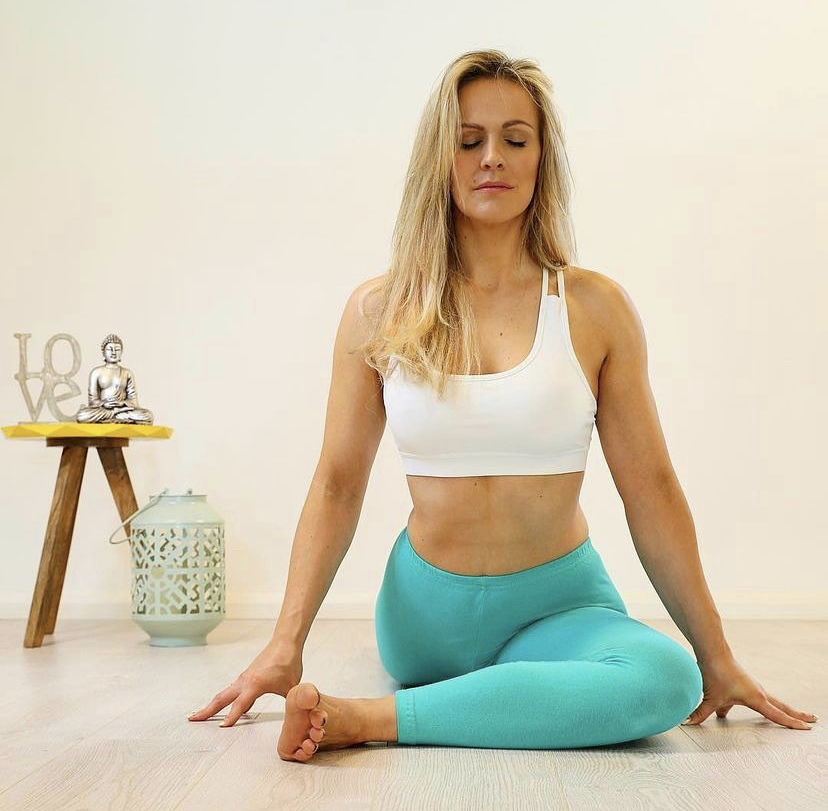
When you’re teaching this pose to your students we need to ensure their hips are square, so if not w can offer a block here. Or sometimes the back leg isn’t straight so a verbal cue here to check the back leg is in line with the hip and we’re resting on the top of the foot with the toe pointing straight back can help.
How to prepare for pigeon pose?
We need to warm through the lower back and into the hips, so we can consider poses like:
Reclined Bound Angle
Reclined Pigeon Pose
Cobra Pose
Warrior 2
Deep Forward Fold
Low and High Lunge
Where to include pigeon pose in a yoga class?
Pigeon Pose isn’t something you want to move in and out of quickly, it’s a pose that you want to allow students to be in for at least 5 breaths once they’re in and settled, encourage them to really use their exhales to soften and deepen into the pose.
So because of this it can be use within a Middle 2 section of your class, so just prior to bringing them into a cool down section ..or you could hold for a little longer than 5 breaths and have this pose feature within a cool down, with perhaps the option after being upright for 5 breaths to soften forwards maybe even into a complete fold if that’s something they’d like to do for an additional 5 breaths.
How to cool down after pigeon pose?
So in a class where we’ve focussed on Pigeon Pose in upright position expanding the heart space, when we look to counter these movements for the final part we can use poses like bringing the knees into the chest, Happy Baby.
For the hips, some internal rotation to close and cool, so things like Cow Face Pose, Hero, or simply windscreen wiper the legs.
For the lower back we could offer a Seated Forward Fold or Childs Pose.
Want to know more?
If you’ve found them interesting and would like to learn more about poses, and planning classes, perhaps take a look over our teacher training courses on the courses section of our website, we offer 200hr Yoga Teacher Training, 300hr Yoga Teacher Training or the combined 500hr Yoga Teacher Training. Or you can email info@yogacourse.com with any questions.


hey there!
.jpg)
We would like our blog to be a place where you learn new things in the world of yoga, when it comes to business of yoga, asanas, philosophy and pranayama.


.jpg)
