Chaturanga vs. Ashtanga Namaskar ..what’s the difference?
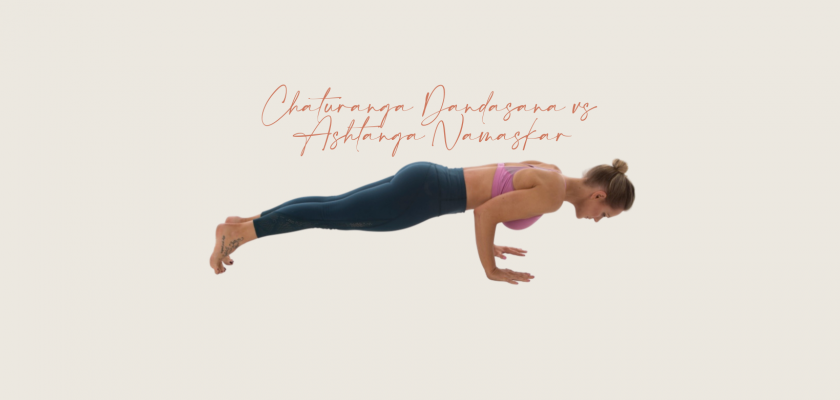
These two poses regularly feature in yoga classes, and often at the same point during a Sun Salutations so can, and are quite easily confused. So lets look at them individually…
Chaturanga Dandasana
Four-Limbed Staff Pose (Chaturanga Dandasana) is probably one of the most misunderstood postures that is done regularly in yoga classes. It’s a challenging postures that works the shoulders, arms, wrists, and also the abdominals. It also has benefits in terms of the spine. As it is a challenging posture there are some things to be mindful of before putting it into your daily practice. Anyone with carpal tunnel or any other wrist injury might prefer to do this on the fists, or by lowering onto the forearms. Anyone with reverse injuries to the arms, back or shoulder should consider the modified version of lowering the knees.
If you’re teaching this pose, some thing to watch out for in your students should be the hip alignment, front half or back half the body being lower than the other, elbows pointing outward, sinking in the belly, or the shoulders dipping forwards.
So how do you do this pose I hear you ask, well… generally we start in a Plank pose initially making sure your core is engaged. All you do from here is push forwards so you bring your shoulders over the top of your shoulders, but the body remains in one straight line. This is where you have the option to modify and lower the knees to the mat. This is where it can become challenging, here we start to bend the elbows to 90 degrees, but we need to make sure the elbows stay pointing back behind us, they need to gently brush the side body ..and voila you’re in the pose! Staying here in this hover for at least an inhale, but sometimes longer.
To exit, we keep that straight line, and either lower straight to the mat, or perhaps roll forwards over the toes and lift into an Upward Facing Dog - this sequence features in Sun Salutations A and B. If you were using Chaturanga in another part of class you may choose to exit by pressing back into a Plank.

Ashtanga Namaskar
So the similarities of this pose and Chaturanga are that the contraindications and cautions are very similar, also in terms of what to watch out for when teaching, the elbows splaying out is also a misalignment to look for.
Some other things to watch out for when teaching are students feet lifting or toes untucking. Hips lowering to the mat with the chest, or the chest lowering in-front of behind the hands rather than in-between.
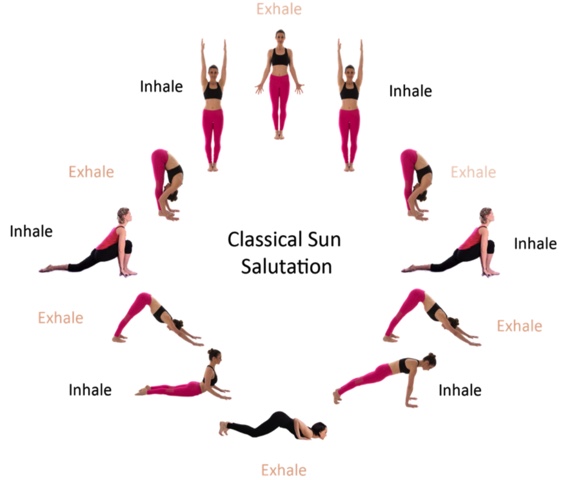
For this pose again we’ll start in Plank Pose, but this time we’ll lower the knees, keeping the toes tucked under. Then we shift forwards bringing the shoulders over the fingertips, but then we lift the tailbone and sink the belly, keep the elbows drawn in, and lower just the chest to the mat between the hands, keeping the sitting bones lifted ..then lower the chin, so you have 8 points connected to the floor - two sets of toes, two knees, two hands, chest and chin. We stay here again for at least a breath. You could exit the way you came, but most commonly, and certainly within the Classical Sun Salutation that this pose features, we sweep forwards and lift into a Cobra.
Want to know more?
If you’d like to learn more about sequencing, poses or Sun Salutations we have modules on all of these within our 200hr Yoga Teacher Training, we also have advanced asana modules within our 300hr Yoga Teacher Training - and of course the 500hr Yoga Teacher Training we offer covers them all! If you have any questions you can email info@yogacourse.com


hey there!

We would like our blog to be a place where you learn new things in the world of yoga, when it comes to business of yoga, asanas, philosophy and pranayama.


